
Weekly Retail Industry Unemployment Report: Australia
Prepared for: aussiework.au
Report date: 17 June 2026
Author: Manus AI
SEO details for WordPress
|
Field
|
Recommended text
|
|
SEO title
|
Australia Retail Unemployment Report: Weekly Update for 17 June 2026
|
|
Meta description
|
Weekly Australia retail labour-market update covering retail unemployment, retail job demand, Coles, BIG W, Kmart and Bunnings examples, plus a practical hiring tip.
|
|
Suggested slug
|
australia-retail-unemployment-report-17-june-2026
|
|
Focus keywords
|
retail unemployment Australia, retail jobs Australia, retail hiring, Australian retail industry
|
Executive summary
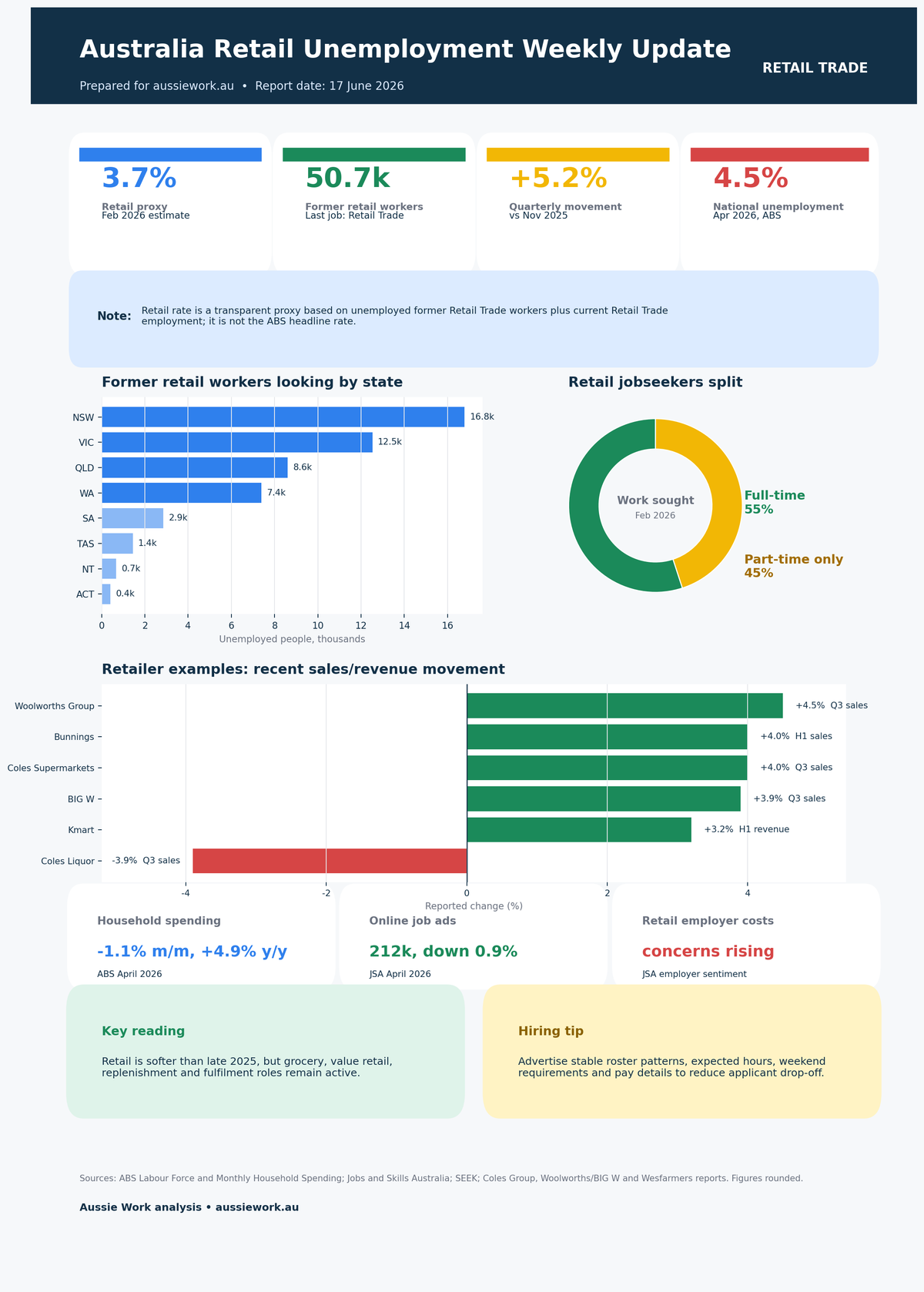
Australia’s retail labour market is cooling, but not collapsing. The latest ABS headline labour-force release remains April 2026, with the next national update scheduled for 25 June 2026. In April, the national seasonally adjusted unemployment rate rose to 4.5%, employment fell by 18,600 people, and the number of unemployed people increased by 33,000 to 692,500.1 The trend unemployment rate, which smooths monthly volatility, remained at 4.3%.1
For Retail Trade specifically, the latest official industry labour-force detail remains February 2026. ABS detailed industry data are quarterly, and the previous detailed release was the final issue under the Labour Force, Australia, Detailed title while the ABS modernises Labour Force Survey outputs.2 Using ABS unemployed-persons data by industry of last job, combined with Retail Trade employment, Aussie Work estimates a retail unemployment proxy of 3.7% for February 2026. Around 50,700 unemployed people had last worked in Retail Trade, up 5.2% from the previous quarter but down 4.0% from a year earlier.2
|
Indicator
|
Latest reading
|
Weekly interpretation for retail
|
|
National unemployment rate
|
4.5% in April 2026, seasonally adjusted
|
The broader labour market has loosened, which may increase applications for retail roles.1
|
|
Retail unemployment proxy
|
3.7% in February 2026
|
Retail-specific unemployment remains moderate, not severe.2
|
|
Unemployed former retail workers
|
50,700 people in February 2026
|
Candidate supply has improved slightly since November, but remains lower than a year earlier.2
|
|
Retail employment
|
About 1.34 million workers in February 2026
|
Retail remains one of Australia’s largest employment pathways.3
|
|
Online job advertisements
|
212,000 in April 2026
|
Labour demand is softer month-to-month but still about 25% above the 2019 average.4
|
What changed this week
The most useful new context comes from spending and employer-sentiment indicators rather than from a new retail unemployment release. ABS household spending data show that total household spending fell 1.1% month-on-month in April 2026, although it was still 4.9% higher than April 2025.5 Retail Asia, summarising ABS and Australian Retail Council commentary, reported that retail spending rose 5.1% year-on-year in April to $39.07 billion, but also noted that much of the annual increase continued to reflect inflation rather than stronger goods volumes.6
This matters for hiring because retailers can see higher dollar sales while still being cautious about labour costs. April spending fell month-on-month in several categories that matter to retail rosters, including food at -1.3% and clothing and footwear at -2.2%.5 At the same time, Jobs and Skills Australia reported that employer cost-pressure concerns increased from under 10% of employers in March to almost 30% by mid-April, with large increases reported across Wholesale Trade, Retail Trade and Manufacturing.7
Weekly reading: Retail employers are not facing a jobs crash, but they are operating in a tighter margin environment. Many will continue hiring for essential store coverage, fulfilment, replenishment and reliable weekend availability, while being more selective about discretionary labour hours.
Retail unemployment estimate
ABS does not publish a simple monthly “retail unemployment rate” equivalent to the national unemployment rate. For a practical weekly industry report, the best transparent method is to compare the number of unemployed people whose last job was in Retail Trade with current Retail Trade employment.
Retail unemployment proxy: unemployed people whose last job was Retail Trade divided by current Retail Trade employment plus unemployed people whose last job was Retail Trade.
|
Retail labour-market measure
|
Latest estimate
|
|
Reference period
|
February 2026
|
|
Retail Trade employed workers
|
About 1.34 million
|
|
Unemployed people whose last job was Retail Trade
|
50,700
|
|
Estimated retail unemployment proxy
|
3.7%
|
|
Full-time work seekers among unemployed former retail workers
|
27,900, or about 55%
|
|
Part-time-only work seekers among unemployed former retail workers
|
22,800, or about 45%
|
|
Average job-search duration for unemployed former retail workers
|
17.9 weeks
|
The proxy rose from 3.5% in November 2025 to 3.7% in February 2026, which shows a slightly looser retail labour market.2 However, the annual comparison is more stable: the number of unemployed former retail workers was still about 2,100 lower than in February 2025.2 That means the retail candidate pool has improved, but employers should not assume that every vacancy will be easy to fill.
Where former retail workers are looking
The largest pools of unemployed former retail workers are in Australia’s largest labour markets. These figures are useful for recruitment planning, but they should not be read as state unemployment rates because they are not adjusted for each state’s retail workforce size.
|
State or territory
|
Unemployed people whose last job was Retail Trade, February 2026
|
|
New South Wales
|
16,800
|
|
Victoria
|
12,500
|
|
Queensland
|
8,600
|
|
Western Australia
|
7,400
|
|
South Australia
|
2,900
|
|
Tasmania
|
1,400
|
|
Northern Territory
|
700
|
|
Australian Capital Territory
|
400
|
For employers, the practical point is that application volumes are likely to be more favourable in NSW and Victoria than in smaller markets, but candidate quality will still depend on roster design, award clarity, transport access and how quickly applicants are contacted.
Retail demand and job-ad signals
Recruitment demand is softer than the post-pandemic peak, but still elevated compared with the pre-pandemic labour market. Jobs and Skills Australia reported 212,000 online job advertisements in April 2026, down 0.9% over the month, while still around 25% above the monthly average for 2019.4 SEEK’s February dashboard showed that national job ads fell 0.5% month-on-month and were 2.6% lower year-on-year, but Retail & Consumer Products was one of the few industries to record monthly growth, up 0.9%.8
|
Hiring signal
|
Latest available reading
|
What it suggests
|
|
JSA Internet Vacancy Index
|
Ads fell 0.9% to 212,000 in April 2026
|
Hiring demand is easing but still historically elevated.4
|
|
SEEK national job ads
|
Down 0.5% month-on-month and 2.6% year-on-year in February
|
Employers are cautious across the broader economy.8
|
|
SEEK Retail & Consumer Products
|
Up 0.9% month-on-month in February
|
Retail hiring held up better than many professional sectors.8
|
|
JSA employer sentiment
|
Cost-pressure concerns rose sharply by mid-April
|
Retailers may keep hiring, but with tighter control on hours and productivity.7
|
Retailer examples: who is up and who is down?
Recent company updates show a split retail market. Food, value, convenience and e-commerce-linked retailers remain relatively resilient, while liquor and some discretionary categories face more pressure. These examples help explain why retail unemployment can rise slightly while some employers are still advertising.
|
Retailer or segment
|
Recent movement
|
Job-market meaning
|
|
Coles Supermarkets
|
Sales revenue up 4.0% in Q3 FY26; comparable sales up 3.6%
|
Supports ongoing demand for checkout, online fulfilment, replenishment and department staff.9
|
|
Coles Liquor
|
Sales revenue down 3.9%; comparable sales down 4.3%
|
Softer liquor trading may reduce hours or slow hiring in weaker locations.9
|
|
Woolworths Group
|
Q3 sales up 4.5% to A$18.09 billion
|
Large food retailers remain major employment anchors.10
|
|
BIG W
|
Q3 sales up 3.9%; Easter-adjusted sales up 1.1%
|
Growth is positive but modest after calendar adjustment, suggesting targeted rather than broad hiring.11
|
|
Kmart
|
H1 FY26 revenue up 3.2% to $6.4 billion
|
Value-led retail remains well positioned as shoppers manage cost-of-living pressure.12
|
|
Bunnings
|
H1 FY26 sales up 4.0% to $10.6 billion
|
Hardware and home-improvement demand continues to support store and supply-chain staffing.12
|
The clearest opportunity for jobseekers is in supermarkets, discount department stores, replenishment, online fulfilment, storeperson work and customer-service roles. For employers, the clear risk is that strong applicants may still choose roles with more predictable hours, faster onboarding and clearer pay information.
Practical hiring tip for retail employers
Retail employers should use this period to hire for reliability, not just availability. With unemployment slightly higher and retail candidate supply a little better than late 2025, employers may receive more applications, but the best candidates will still compare rosters, travel time and pay transparency.
A stronger retail job ad should state the expected weekly hours, likely shift pattern, weekend requirement, award classification or pay range, training period and whether the role has a pathway into supervisor, online fulfilment, stockroom or storeperson work. For many applicants, a clear roster such as “three fixed shifts per week, including Saturday morning” is more attractive than a vague requirement to be “available seven days”. Clearer rosters reduce applicant drop-off, improve attendance after hiring and help small retailers compete with larger chains.
Outlook for the next report
The next key data date is 25 June 2026, when ABS is scheduled to release both the May 2026 Labour Force update and the May 2026 Monthly Household Spending Indicator.1 5 Jobs and Skills Australia is also scheduled to release May 2026 Internet Vacancy Index data on 24 June 2026.4 Those releases should provide a clearer read on whether the April softening in spending and job ads is temporary or becoming a stronger trend.
For now, the retail labour-market message for aussiework.au readers is balanced. Retail unemployment is higher than late 2025 on the proxy measure, but still moderate. Retail dollars are up over the year, but costs and inflation are squeezing employers. Jobseekers should prioritise grocery, value retail, fulfilment and replenishment roles, while employers should make rosters and pay expectations clear from the first job ad.
References – Footnotes
1.Australian Bureau of Statistics, Labour Force, Australia, April 2026. ↩ ↩2 ↩3 ↩4
3.Jobs and Skills Australia, Retail Trade industry profile. ↩
4.Jobs and Skills Australia, Internet Vacancy Index, April 2026. ↩ ↩2 ↩3 ↩4
5.Australian Bureau of Statistics, Monthly Household Spending Indicator, April 2026. ↩ ↩2 ↩3
7.Jobs and Skills Australia, Rising costs and fuel disruptions shift employer sentiment in early 2026. ↩ ↩2
8.SEEK, SEEK Employment Dashboard, February 2026. ↩ ↩2 ↩3
9.Coles Group, 2026 Third Quarter Sales Results. ↩ ↩2
10.Retail Insight Network, Woolworths posts 4.5% rise in Q3 sales. ↩
11.Ragtrader, Clothing drives Big W sales in third quarter. ↩
12.Inside Retail Australia, Bunnings, Kmart lead earnings growth for Wesfarmers. ↩ ↩2