
Weekly Retail Industry Unemployment Report: Australia
Prepared with AI for: aussiework.au
Report date: 24 June 2026
SEO details for WordPress
|
Field
|
Recommended text
|
|
SEO title
|
Australia Retail Unemployment Report: Weekly Update for 24 June 2026
|
|
Meta description
|
Weekly Australia retail labour-market update covering retail unemployment, retail job ads, EOFY sales, Coles, BIG W and Woolworths examples, plus a practical hiring tip.
|
|
Suggested slug
|
australia-retail-unemployment-report-24-june-2026
|
|
Focus keywords
|
retail unemployment Australia, retail jobs Australia, retail hiring, Australian retail industry, retail job ads
|
Executive summary
Australia’s retail labour market is still active, but hiring demand is clearly cooling. The latest ABS headline labour-force release remains April 2026, because the ABS has delayed April to August 2026 Labour Force releases by one week while modernizing the Labour Force Survey. The next national unemployment update is due on 25 June 2026.1 2
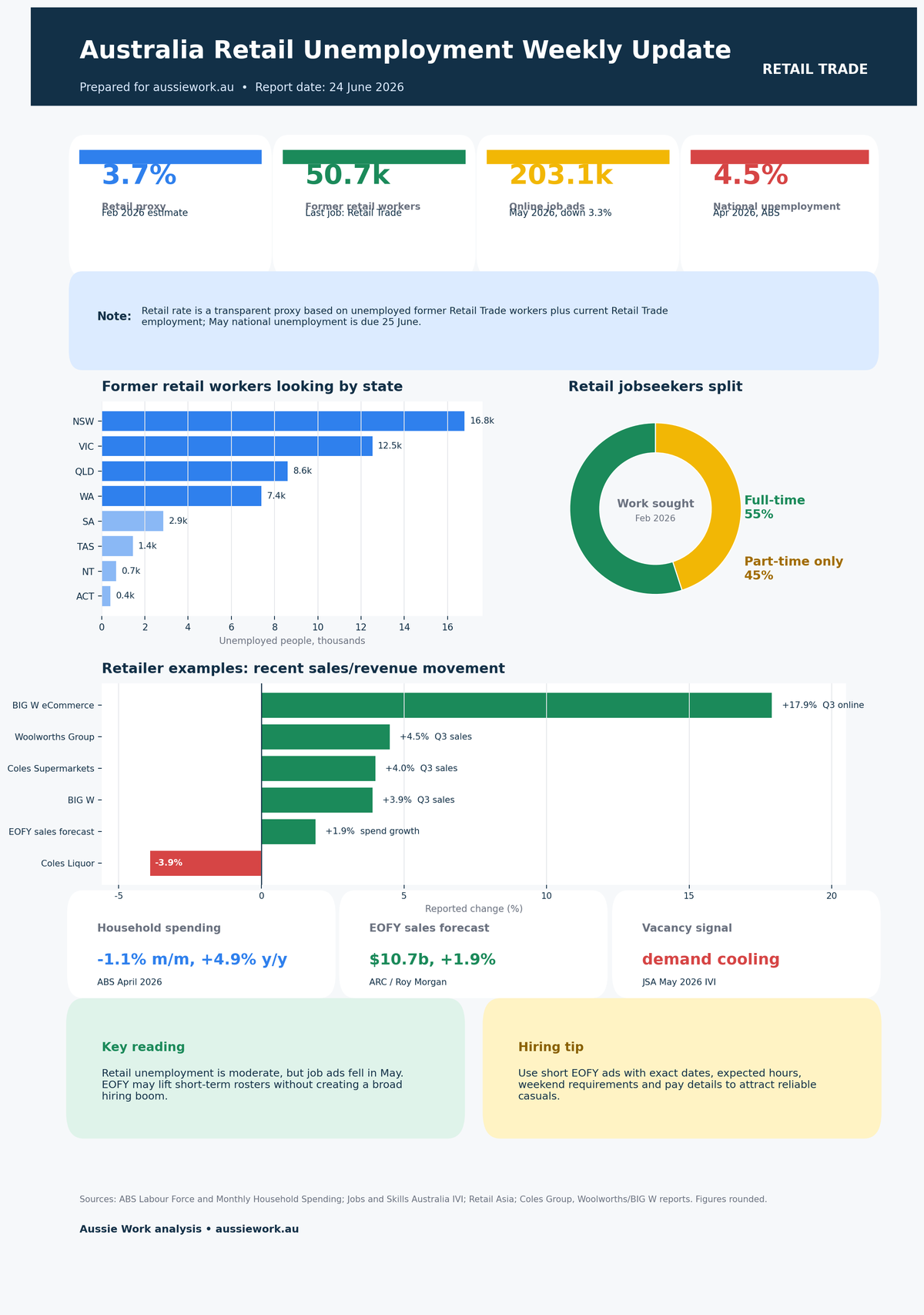
In the April release, Australia’s seasonally adjusted unemployment rate rose to 4.5%, employment fell by 18,600 people, and the number of unemployed people rose by 33,000 to 692,500.1 For the Retail Trade industry specifically, the latest detailed ABS industry labour-force data remain February 2026. Using unemployed people whose last job was in Retail Trade, combined with current Retail Trade employment, Aussie Work estimates a retail unemployment proxy of 3.7%.3
The main new signal this week is from Jobs and Skills Australia. Online job advertisements fell 3.3% in May 2026 to 203,100, although advertisement numbers remain around 20% above the monthly average for 2019.4 That means retailers may still be hiring, but they are likely to be more selective, more cost-conscious and more careful with casual hours than earlier in the year.
|
Indicator
|
Latest reading
|
Weekly interpretation for retail
|
|
National unemployment rate
|
4.5% in April 2026
|
The broader labour market has loosened, but the May update is due tomorrow.1
|
|
Retail unemployment proxy
|
3.7% in February 2026
|
Retail-specific unemployment remains moderate, not severe.3
|
|
Unemployed former retail workers
|
50,700 in February 2026
|
Candidate supply is slightly better than late 2025 but lower than a year earlier.3
|
|
Online job advertisements
|
203,100 in May 2026
|
Job ads fell 3.3% month-on-month, showing softer hiring demand.4
|
|
EOFY sales forecast
|
$10.7 billion
|
Short-term sales activity may support roster needs, but growth is expected to be below inflation.5
|
What changed this week
The most important weekly change is the new May 2026 Internet Vacancy Index from Jobs and Skills Australia. Online job advertisements fell by 7,000, or 3.3%, to 203,100 in May.4 This is a meaningful softening signal for employers and jobseekers because job advertisements are one of the timelier measures of labour demand.
At the same time, retail trading is entering the end-of-financial-year sales period. Retail Asia reported Australian Retail Council and Roy Morgan data suggesting about 6.1 million Australians, or 26% of the population, are expected to shop during EOFY sales, with total spending forecast at $10.7 billion.5 However, expected spending growth is only 1.9%, below inflation, which suggests retailers may need staff for peak sales coverage without assuming a broad spending boom.5
Weekly reading: Retail employers are likely to need short-term coverage for EOFY sales, especially in apparel, appliances, white goods, electronics and online fulfilment, but the falling job-ad trend suggests many businesses will control hours tightly and prioritize reliable, productive staff.
Retail unemployment estimate
ABS does not publish a simple monthly “retail unemployment rate” in the same format as the national unemployment rate. For this report, the most transparent practical method is to use unemployed people whose last job was in Retail Trade and compare them with current Retail Trade employment.
Retail unemployment proxy: unemployed people whose last job was Retail Trade divided by current Retail Trade employment plus unemployed people whose last job was Retail Trade.
|
Retail labour-market measure
|
Latest estimate
|
|
Reference period
|
February 2026
|
|
Retail Trade employed workers
|
About 1.34 million
|
|
Unemployed people whose last job was Retail Trade
|
50,700
|
|
Estimated retail unemployment proxy
|
3.7%
|
|
Full-time work seekers among unemployed former retail workers
|
27,900, or about 55%
|
|
Part-time-only work seekers among unemployed former retail workers
|
22,800, or about 45%
|
|
Average job-search duration for unemployed former retail workers
|
17.9 weeks
|
The proxy rose from 3.5% in November 2025 to 3.7% in February 2026, indicating that the retail labour market became slightly looser in early 2026.3 However, the annual comparison remains more reassuring: the number of unemployed former retail workers was still about 4.0% lower than in February 2025.3 In practical terms, more applicants may be available than late last year, but retailers should not assume every location will be easy to staff.
Where former retail workers are looking
The largest pools of unemployed former retail workers are in the largest state labour markets. These figures are useful for planning recruitment campaigns, but they are not state unemployment rates because they do not adjust for the size of each state’s retail workforce.
|
State or territory
|
Unemployed people whose last job was Retail Trade, February 2026
|
|
New South Wales
|
16,800
|
|
Victoria
|
12,500
|
|
Queensland
|
8,600
|
|
Western Australia
|
7,400
|
|
South Australia
|
2,900
|
|
Tasmania
|
1,400
|
|
Northern Territory
|
700
|
|
Australian Capital Territory
|
400
|
For employers, this means NSW and Victoria may provide the broadest candidate pools. In smaller and regional markets, retailers may still need to compete through predictable rosters, quick callbacks and clear pay information.
Retail demand and job-ad signals
Retail hiring conditions now look more selective. The national online job-ad count remains above pre-pandemic levels, but the monthly fall in May shows businesses are becoming more cautious.4 This aligns with the April household spending picture: ABS reported household spending fell 1.1% month-on-month, while still being 4.9% higher than April 2025.6
|
Hiring or spending signal
|
Latest available reading
|
What it suggests
|
|
JSA Internet Vacancy Index
|
203,100 ads in May, down 3.3%
|
Labour demand is easing further, even though ads remain elevated versus 2019.4
|
|
ABS household spending
|
Down 1.1% month-on-month in April
|
Consumers remain cautious after a stronger March.6
|
|
Food spending
|
Down 1.3% month-on-month in April
|
Even essential categories softened in the latest spending data.6
|
|
Clothing and footwear spending
|
Down 2.2% month-on-month in April
|
Discretionary retail categories may be more roster-sensitive.6
|
|
EOFY sales
|
$10.7 billion expected
|
Short-term traffic may rise, but growth below inflation points to careful labour planning.5
|
The key point is that retail is not facing a sudden unemployment shock, but the hiring market is shifting from “fill urgently” to “fill carefully”. Employers may still advertise for peak sales periods, but they are likely to favour people who can work specific high-value shifts, handle stock movement, support online orders and convert customer traffic efficiently.
Retailer examples: who is up and who is down?
Retailer updates show a mixed market. Supermarkets, value retail and e-commerce-linked activity remain stronger than some discretionary and liquor categories. These examples help explain why unemployment can rise slightly while some large retailers continue hiring in targeted areas.
|
Retailer or segment
|
Recent movement
|
Job-market meaning
|
|
Coles Supermarkets
|
Sales revenue up 4.0% in Q3 FY26; comparable sales up 3.6%
|
Grocery remains a stable employer for checkout, replenishment, online fulfilment and fresh-food roles.7
|
|
Coles Liquor
|
Sales revenue down 3.9%; comparable sales down 4.3%
|
Softer liquor trading may reduce hours or slow hiring in weaker locations.7
|
|
Woolworths Group
|
Q3 sales up 4.5% to A$18.09 billion
|
Major food retailers remain important employment anchors.8
|
|
BIG W
|
Q3 sales up 3.9%; Easter-adjusted sales up 1.1%
|
Growth is positive but modest after calendar adjustment, suggesting targeted hiring for store and online demand.9
|
|
BIG W e-commerce
|
Sales exceeded $100 million and rose 17.9%
|
Online fulfilment and stock accuracy skills are increasingly valuable.9
|
|
EOFY retail sales
|
$10.7 billion expected across Australia
|
Temporary staff may be needed, but below-inflation sales growth favours tight roster control.5
|
The clearest jobseeker opportunities remain in supermarkets, value retail, online fulfilment, replenishment, customer service and storeperson-style roles. For employers, the clear risk is losing reliable applicants to competitors that provide clearer hours and faster hiring decisions.
Practical hiring tip for retail employers
Retail employers should use EOFY hiring to test short, clearly defined roster offers rather than broad and vague casual ads. The strongest candidates often need to coordinate study, childcare, transport or a second job, so clarity is a competitive advantage.
A strong retail job ad should state the exact sales period, likely weekly hours, weekend requirements, award classification or pay range, training shift, and whether strong casuals can move into ongoing work after the sales period. For example, “EOFY casual: 18–24 hours per week for four weeks, including Thursday night and Saturday, with possible ongoing replenishment shifts” is more useful than “must be available seven days”. This approach helps employers attract reliable applicants while avoiding overcommitment in a cooling job-ad market.
Outlook for the next report
The next 24 hours are important for labour-market reporting. ABS is scheduled to release the May 2026 Labour Force and May 2026 Monthly Household Spending Indicator on 25 June 2026.1 6 Those releases may materially update the national unemployment and consumer-spending picture. Jobs and Skills Australia’s next Internet Vacancy Index release, covering June 2026, is scheduled for 22 July 2026.4
For aussiework.au readers, the message is balanced. Retail unemployment is moderate on the latest industry proxy, but job ads are falling and employers are more cautious. Jobseekers should prioritize roles linked to grocery, value retail, fulfilment and EOFY stock flow. Employers should keep job offers precise, move quickly on reliable candidates and avoid vague availability requirements that discourage strong applicants.
Footnotes
1.Australian Bureau of Statistics, Labour Force, Australia, April 2026. ↩ ↩2 ↩3 ↩4
2.Australian Bureau of Statistics, Modernising the Labour Force Survey. ↩
7.Coles Group, 2026 Third Quarter Sales Results. ↩ ↩2
8.Retail Insight Network, Woolworths posts 4.5% rise in Q3 sales. ↩
9.Ragtrader, Clothing drives Big W sales in third quarter. ↩ ↩2