
Weekly Retail Industry Unemployment Report: Australia
Prepared for: aussiework.au
Report date: 1 July 2026
Author: Manus AI
Executive summary
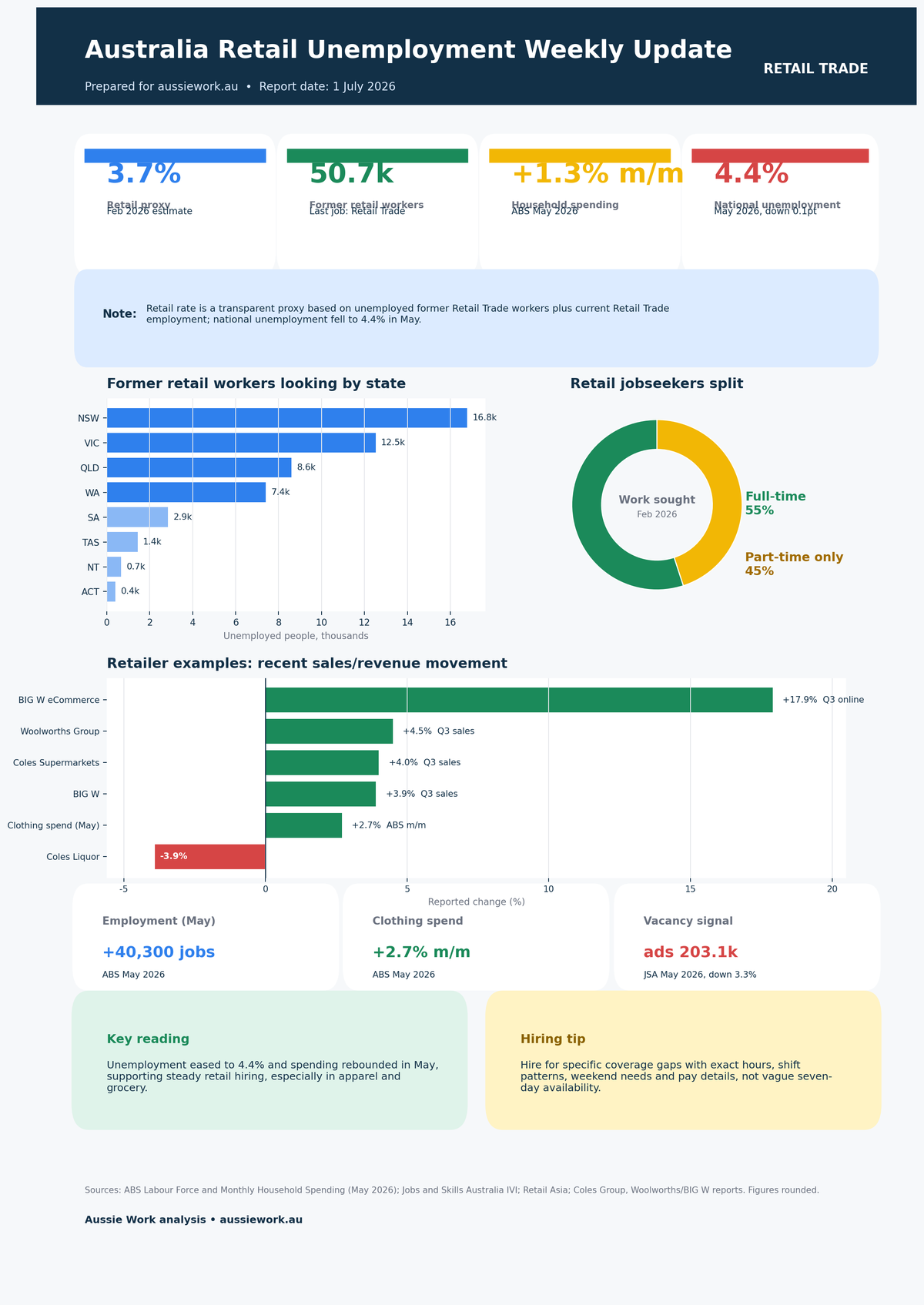
Australia’s retail labor market is finding its footing after a softer period. The broader labor market improved in the latest ABS headline release for May 2026. The national seasonally adjusted unemployment rate fell slightly to 4.4%, employment rose by 40,300 people, and the number of unemployed people fell by 18,300 to 671,300.1
For the Retail Trade industry specifically, the latest official detailed industry labor-force data remain February 2026. Using the number of unemployed people whose last job was in Retail Trade, combined with current Retail Trade employment, Aussie Work estimates a retail unemployment proxy of 3.7%.2 While the proxy is slightly looser than late 2025, the new May headline employment and spending data suggest retail demand held up better heading into winter than April figures implied.
|
Indicator
|
Latest reading
|
Weekly interpretation for retail
|
|
National unemployment rate
|
4.4% in May 2026
|
The broader labour market rebounded slightly, meaning retail still faces competition for the best applicants.1
|
|
Retail unemployment proxy
|
3.7% in February 2026
|
Retail-specific unemployment remains moderate and relatively contained.2
|
|
Unemployed former retail workers
|
50,700 in February 2026
|
Candidate supply is slightly better than late 2025 but lower than a year earlier.2
|
|
Online job advertisements
|
203,100 in May 2026
|
Job ads fell 3.3% month-on-month, showing employers are still hiring carefully.3
|
|
Household spending
|
Up 1.3% month-on-month in May
|
A solid spending rebound, led by clothing and footwear, supports short-term roster needs.4
|
What changed this week
The most important updates this week are the new May 2026 Labor Force and Monthly Household Spending Indicator releases from the ABS. Both paint a more resilient picture than the April data.
National employment grew by 40,300, driven entirely by part-time roles (+35,200), which is often a positive signal for retail and hospitality capacity.1 At the same time, household spending rose 1.3% month-on-month in May, reversing April’s fall. The strongest spending growth was in clothing and footwear (+2.7%), miscellaneous goods and services (+2.2%), and hotels, cafes and restaurants (+1.9%).4
Weekly reading: Retail employers are managing a delicate balance. Consumers opened their wallets again in May, especially for apparel and dining, which supports immediate store coverage needs. However, the longer-term trend in job advertisements is still softening, meaning retailers are filling essential shifts but avoiding overstaffing.
Retail unemployment estimate
Because the ABS does not publish a simple monthly “retail unemployment rate” in the same format as the national rate, the most transparent practical method is to compare unemployed people whose last job was in Retail Trade with current Retail Trade employment.
Retail unemployment proxy: unemployed people whose last job was Retail Trade divided by current Retail Trade employment plus unemployed people whose last job was Retail Trade.
|
Retail labor-market measure
|
Latest estimate
|
|
Reference period
|
February 2026
|
|
Retail Trade employed workers
|
About 1.34 million
|
|
Unemployed people whose last job was Retail Trade
|
50,700
|
|
Estimated retail unemployment proxy
|
3.7%
|
|
Full-time work seekers among unemployed former retail workers
|
27,900, or about 55%
|
|
Part-time-only work seekers among unemployed former retail workers
|
22,800, or about 45%
|
|
Average job-search duration for unemployed former retail workers
|
17.9 weeks
|
The proxy rose from 3.5% in November 2025 to 3.7% in February 2026, indicating that the retail labor market loosened slightly early in the year.2 However, the number of unemployed former retail workers remains about 4.0% lower than in February 2025.2 This means the retail candidate pool is healthy but not flooded, and good candidates still have options.
Where former retail workers are looking
The largest pools of unemployed former retail workers are in the largest state labor markets. These figures are useful for planning recruitment, but they are not state unemployment rates because they do not adjust for the size of each state’s retail workforce.
|
State or territory
|
Unemployed people whose last job was Retail Trade, February 2026
|
|
New South Wales
|
16,800
|
|
Victoria
|
12,500
|
|
Queensland
|
8,600
|
|
Western Australia
|
7,400
|
|
South Australia
|
2,900
|
|
Tasmania
|
1,400
|
|
Northern Territory
|
700
|
|
Australian Capital Territory
|
400
|
For employers, this means NSW and Victoria may provide the highest volume of applicants. In smaller and regional markets, retailers must continue to compete by offering predictable rosters, quick callbacks and clear pay information.
Retail demand and job-ad signals
The contrast between rising consumer spending and falling job ads defines the current market. Jobs and Skills Australia reported 203,100 online job advertisements in May 2026, down 3.3% over the month, though still around 20% above the monthly average for 2019.3 Meanwhile, ABS household spending rose 1.3% month-on-month and 5.5% year-on-year in May.4
|
Hiring or spending signal
|
Latest available reading
|
What it suggests
|
|
JSA Internet Vacancy Index
|
203,100 ads in May, down 3.3%
|
Employers are hiring more selectively and replacing staff slower.3
|
|
ABS household spending
|
Up 1.3% month-on-month in May
|
Consumers rebounded after a quiet April, supporting retail cash flow.4
|
|
Clothing and footwear spending
|
Up 2.7% month-on-month in May
|
Apparel retailers may need extra coverage to handle winter stock movement.4
|
|
Food spending
|
Up 1.1% month-on-month in May
|
Grocery remains a stable driver of retail employment.4
|
|
EOFY sales
|
$10.7 billion expected
|
End-of-financial-year traffic supports temporary roster needs.5
|
The key point is that retailers are seeing enough sales to justify maintaining their workforce, but not enough confidence to launch major expansion drives. They are likely to favor applicants who can hit the ground running, handle stock efficiently, and convert customer traffic.
Retailer examples: who is up and who is down?
Recent company updates highlight the resilience of grocery, value retail, and e-commerce. These examples help explain why unemployment can remain moderate while some large retailers continue targeted hiring.
|
Retailer or segment
|
Recent movement
|
Job-market meaning
|
|
Coles Supermarkets
|
Sales revenue up 4.0% in Q3 FY26; comparable sales up 3.6%
|
Grocery remains a stable employer for checkout, replenishment and online fulfilment.6
|
|
Coles Liquor
|
Sales revenue down 3.9%; comparable sales down 4.3%
|
Softer liquor trading may reduce hours or slow hiring in weaker locations.6
|
|
Woolworths Group
|
Q3 sales up 4.5% to A$18.09 billion
|
Major food retailers remain important employment anchors.7
|
|
BIG W
|
Q3 sales up 3.9%; Easter-adjusted sales up 1.1%
|
Modest underlying growth suggests targeted hiring for store and online demand.8
|
|
BIG W e-commerce
|
Sales exceeded $100 million and rose 17.9%
|
Online fulfilment and stock accuracy skills are increasingly valuable.8
|
The clearest jobseeker opportunities remain in supermarkets, value retail, online fulfilment, replenishment, customer service and store person roles. For employers, the clear risk is losing reliable applicants to competitors that provide clearer hours and faster hiring decisions.
Practical hiring tip for retail employers
Retail employers should use the May spending rebound to hire for specific coverage gaps rather than over-recruiting. Because job ads are falling generally, you may receive more applications per vacancy, but the best candidates will still compare rosters and pay transparency.
A strong retail job ad should state the exact weekly hours, likely shift pattern, weekend requirement, award classification or pay range, and whether the role involves online fulfilment or stockroom work. For example, “Part-time apparel assistant: 20 hours per week, including Thursday night and Saturday, with strong focus on stock presentation” is much more effective than “retail superstar wanted, must be available seven days”. This approach helps attract reliable applicants who can manage their availability, reducing turnover and training costs.
Outlook for the next report
The next major data release is the June 2026 Internet Vacancy Index from Jobs and Skills Australia, scheduled for 22 July 2026.3 Until then, the market will digest the May employment and spending rebound alongside the results of the EOFY sales period.
For aussiework.au readers, the message is that retail is holding steady. Retail unemployment is moderate, and the May spending rebound shows consumers are still active. Jobseekers should prioritise roles linked to grocery, apparel, value retail, and fulfilment. Employers should keep job offers precise, move quickly on reliable candidates, and use clear rosters to secure the best talent.
Footnotes
1.Australian Bureau of Statistics, Labour Force, Australia, May 2026. ↩ ↩2 ↩3
3.Jobs and Skills Australia, Internet Vacancy Index, May 2026. ↩ ↩2 ↩3 ↩4
5.Retail Asia, Australians expected to spend $10.7b in end-of-financial-year sales. ↩
6.Coles Group, 2026 Third Quarter Sales Results. ↩ ↩2
7.Retail Insight Network, Woolworths posts 4.5% rise in Q3 sales. ↩
8.Ragtrader, Clothing drives Big W sales in third quarter. ↩ ↩2